Fossilised Red Blood Cells Found in Dinosaur Bone
Fossilised Red Blood Cells Found in a 115-Million-Year-Old Dinosaur Bone
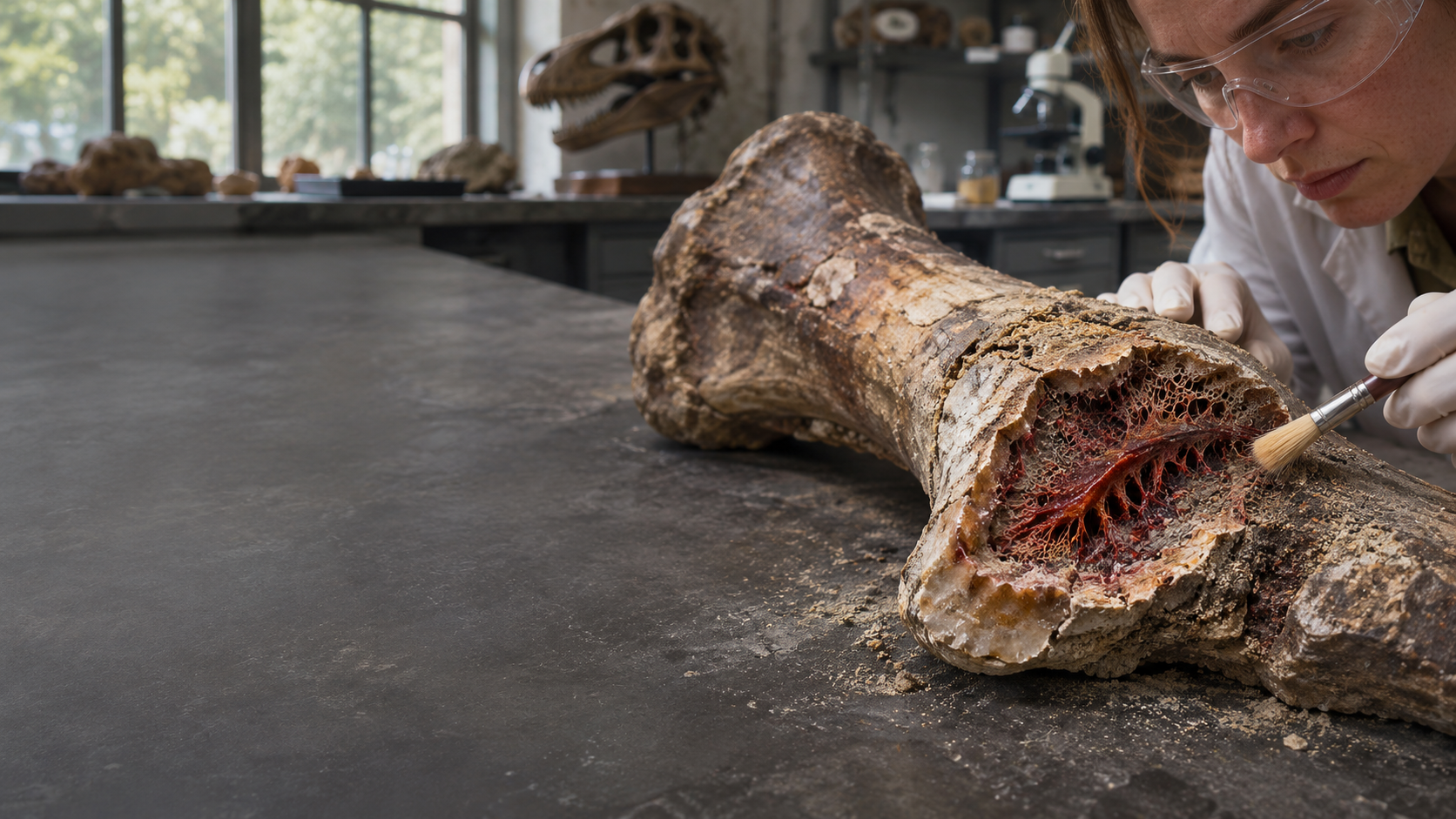
A report describing fossilised red blood cell-like structures inside a dinosaur bone is offering scientists a rare glimpse into the microscopic biology of an animal that lived approximately 115 million years ago. The finding could improve understanding of dinosaur circulation, soft-tissue preservation and the chemical changes that occur during fossilisation. Source 1
Blood cells are soft biological structures. They normally break down soon after death, while bones can remain buried and mineralised for millions of years. Their reported preservation raises an important question: how could structures resembling dinosaur blood cells survive in a fossilised bone for such an immense period?
The answer may involve rapid burial, mineral replacement and unusually stable chemical conditions. However, the discovery does not mean that fresh dinosaur blood remains in the bone. It also does not demonstrate that usable dinosaur DNA survived or make dinosaur cloning possible.
What Scientists Reportedly Found
Scientists reportedly identified microscopic structures interpreted as fossilised red blood cells in the bone of a dinosaur that lived about 115 million years ago. The finding may provide new information about dinosaur biology and the preservation of microscopic tissue features. Source 3
In a living vertebrate, red blood cells transport oxygen through the bloodstream. In a fossil, however, researchers are not examining living cells. They are examining microscopic structures that may preserve the original cells’ shape or mineralised remains.
That distinction matters. The report concerns cell-like structures, not intact blood. It does not establish that the structures remain biologically active, contain recoverable genetic material or preserve an entire dinosaur genome.
The available source summaries do not identify the dinosaur species, precise fossil location or complete laboratory methods. Those details should be confirmed against the original scientific publication before being presented as established facts.
Why the Finding Is Unusual
Soft tissue usually decays much faster than bone. Microorganisms, oxygen, moisture, scavengers and physical disturbance can destroy cells soon after death. Bone is more durable because its mineral structure can resist decay and remain buried for geological periods.
The reported discovery is unusual because red blood cells are fragile. Their preservation suggests that microscopic tissue-like structures can sometimes survive under exceptional fossilisation conditions. It does not mean that all dinosaur fossils contain preserved blood cells or that soft tissues commonly survive unchanged.
Minerals may replace parts of a cell, coat its surface or fill spaces left behind as organic material breaks down. The result can preserve the outline or three-dimensional form of a biological structure even when its original chemistry has been substantially altered.
How Could Blood Cells Survive for 115 Million Years?
Fossilisation is a gradual process in which remains are buried, chemically altered and often mineralised. Several stages may contribute to the preservation of microscopic structures:
- The animal dies and its remains become buried in sediment.
- Burial reduces exposure to scavengers, oxygen and physical disturbance.
- Groundwater moves through the surrounding sediment and bone.
- Dissolved minerals enter microscopic spaces or replace parts of the original material.
- The remains become preserved as fossil material.
The exact process varies between fossils. Age alone does not determine whether tissue survives. Local burial conditions, water chemistry, sediment type, temperature and microbial activity can strongly affect preservation.
Conditions that may improve the chances of preserving delicate structures include:
- Rapid burial after death.
- Low oxygen levels.
- Fine-grained sediment.
- Limited microbial activity.
- Stable chemical conditions.
- Mineral-rich groundwater.
- Reduced exposure to scavengers and erosion.
Bone may offer an additional advantage because its internal spaces can shelter microscopic material from the outside environment. Fluids moving through those spaces may deposit minerals that preserve the shape of structures inside the bone.
Researchers must distinguish between preservation of a cell outline and preservation of the original cell material. A mineralised structure may retain the approximate form of a red blood cell while containing little or none of the original organic substance.
No single preservation mechanism should be treated as confirmed without the complete scientific study. The reported finding shows that exceptional preservation is possible; it does not, by itself, establish exactly how the structures survived.
What “Fossilised” Means Here
The phrase “fossilised red blood cells” may describe structures resembling red blood cells that were preserved, mineralised or replaced during fossilisation. It does not necessarily mean that fresh red blood cells remained unchanged for 115 million years.
To assess the interpretation, scientists need more than visual resemblance. Microscopy can reveal shape, size and distribution. Chemical analysis can show whether the structures have mineral signatures consistent with fossilisation. Geological context can establish whether they are enclosed within the fossil or located on a potentially contaminated surface.
The structures could theoretically represent biological remains, mineral formations or preparation artefacts. Scientific confidence increases when different tests produce consistent results.
How Scientists Identify Possible Dinosaur Blood Cells
Shape and Size
Red blood cells have characteristic forms in living vertebrates, although their size and shape vary between animal groups. Researchers can compare microscopic fossil structures with modern animal cells to determine whether the resemblance is plausible.
Visual similarity alone is not enough for definitive identification. Scientists may examine:
- The size of individual structures.
- Their shape and surface texture.
- Their distribution within the bone.
- Their relationship to blood-vessel spaces.
- Their consistency across multiple areas or samples.
Fossilisation can distort biological structures. Pressure, mineral growth and chemical alteration may change their original dimensions, so comparisons must account for geological modification.
Chemical Analysis
Imaging and chemical techniques can help determine whether cell-like structures are biological remains or inorganic formations. Depending on the study, researchers may use high-powered microscopy, scanning electron microscopy, spectroscopy, elemental analysis or imaging of internal bone structures.
The supplied reports do not provide enough information to confirm which methods were used in this case. Those details require verification from the original paper.
Chemical testing can identify minerals and elements associated with fossilisation. It may also show whether a structure is materially different from the surrounding bone. Such evidence can support an interpretation, but chemical data alone may not prove that a structure was once a red blood cell.
The strongest conclusions usually combine morphology, chemistry and geological context.
Ruling Out Contamination
Contamination is a major concern when ancient biological material is studied. Modern cells, laboratory residues or handling materials could introduce structures that did not originate in the fossil.
Researchers may therefore need to show that:
- The structures are enclosed within the fossil.
- They occur in areas inaccessible to recent contamination.
- Their chemistry differs from modern biological material.
- Laboratory preparation did not create or introduce them.
- Similar structures appear consistently in relevant fossil material.
These controls help distinguish genuine ancient features from modern contamination or preparation artefacts.
What the Discovery Could Reveal About Dinosaur Biology
Evidence of Blood Circulation
If the structures are correctly identified as fossilised red blood cells, they would be associated with a functioning circulatory system. That could provide additional evidence about how the dinosaur transported oxygen through its body.
The finding alone cannot determine whether the dinosaur was warm-blooded or cold-blooded. Red blood cells indicate circulation, but metabolism and body temperature require multiple lines of evidence. Scientists also study anatomy, growth patterns, bone structure, activity levels and comparisons with living animals.
The discovery may nevertheless add a microscopic dimension to research that has traditionally focused on dinosaur skeletons and body proportions.
Comparisons With Living Animals
Fossilised cell structures can be compared with cells from living vertebrates. These comparisons may help researchers investigate possible differences in cell size, cell shape, blood composition, oxygen transport and circulatory adaptations.
Such comparisons require caution. A fossil cell may have been compressed, enlarged, coated with minerals or partly replaced. It should not automatically be considered identical to the red blood cells of a modern bird, reptile or mammal.
Dinosaur Soft Tissues
The reported finding fits into broader research on dinosaur soft-tissue preservation. Fossil evidence can include microscopic structures, skin impressions, feathers, vessels, protein traces and other tissue-like features.
These categories are not equivalent. An anatomical impression differs from mineralised tissue. Mineralised tissue differs from preserved organic molecules. Organic molecules differ from recoverable DNA.
Each type of evidence supports different conclusions. A preserved cell shape may reveal aspects of anatomy or fossilisation, while a chemical residue may provide information about molecular composition. Neither automatically supplies a complete genetic record.
Why Bone Matters
Internal bone spaces may shield biological remnants from exposure to the surrounding environment. Once buried, those spaces can become sites of mineral exchange. Groundwater may carry dissolved substances into the bone, where they fill cavities or replace degraded material.
This process can preserve the shape of microscopic structures even when their original components have disappeared. The bone itself may remain recognisable while the cells inside it undergo extensive chemical alteration.
Different parts of a fossil can experience different conditions. Preservation can vary according to bone porosity, burial depth, water movement, sediment chemistry, temperature, pressure and microbial exposure. Exceptional preservation is therefore not typical of every fossilised dinosaur bone.
Does This Mean Dinosaur DNA Was Found?
No. The reported discovery concerns structures interpreted as fossilised red blood cells, not a confirmed dinosaur genome. DNA is chemically fragile and generally degrades over time. Preserving the shape of a cell does not demonstrate that its genetic material survived.
Cell morphology and molecular preservation are separate scientific questions. A fossil can retain a microscopic outline after the original organic material has been replaced by minerals. Conversely, chemical traces may survive without preserving a recognisable cell shape.
Nothing in the supplied source summaries establishes that complete dinosaur DNA was recovered.
Why This Does Not Make Jurassic Park Possible
The finding has invited comparison with Jurassic Park, the fictional story in which dinosaur DNA is recovered and used to recreate dinosaurs. One report framed the discovery in relation to that cultural reference, but the available summary does not provide additional scientific detail. Source 5
Preserved red blood cell-like structures do not provide a complete genetic blueprint. Creating a viable dinosaur would require extensive intact genetic information, functional DNA, a compatible living cell or equivalent technology, and a suitable developmental system.
The reported finding is scientifically interesting without supporting dinosaur resurrection.
What Scientists Still Need to Establish
The central question is whether the structures are genuinely fossilised red blood cells. Confidence would increase through repeated observations, independent testing, consistent morphology, supporting chemical signatures, clear geological context and comparisons with modern cells and inorganic formations.
Researchers also need to establish whether the structures preserve original biological material or only its mineralised form. Possible categories include:
- Original biological material.
- Mineral replacements.
- Chemical residues.
- Impressions left in the fossil.
This distinction affects what scientists can infer about dinosaur physiology. A preserved shape may provide anatomical information, while surviving molecular material could offer different evidence about composition.
Future research could examine additional specimens, different dinosaur groups, fossils from other environments and remains from other geological periods. Comparing preservation across many fossils could show whether blood-cell-like structures are associated with particular sediment types or burial conditions.
Conclusion
Researchers reportedly found fossilised red blood cell-like structures in the bone of a dinosaur that lived roughly 115 million years ago. The discovery matters because it may provide new clues about dinosaur biology while expanding knowledge of how soft-tissue features can be preserved.
The finding does not mean that living blood survived. It does not establish that complete dinosaur DNA remains in the fossil, and it does not create a realistic path to cloning dinosaurs.
Its broader importance lies in the possibility that fossils can preserve biological clues in unexpected forms. A mineralised microscopic structure inside a bone can still raise major questions about circulation, tissue preservation and the history of life long after the original animal disappeared.
Frequently Asked Questions
Are fossilised red blood cells possible?
Scientists can identify structures that resemble red blood cells after exceptional preservation, mineralisation or chemical replacement. “Fossilised” does not mean the cells remain fresh or biologically functional. Identification depends on morphology, geological context and chemical analysis.
How old are the reported dinosaur blood cells?
The dinosaur lived approximately 115 million years ago. That age refers to the fossil and the geological period of the animal. It does not necessarily mean that unchanged original red blood cells survived for that entire time.
Does this discovery prove that dinosaurs had warm blood?
No. Red blood cells are associated with circulation, but their reported preservation does not independently determine body temperature or metabolism. Scientists need evidence from anatomy, growth patterns, physiology and other fossil data.
Was dinosaur DNA found in the fossil?
Not according to the supplied source summaries. The report concerns structures interpreted as fossilised red blood cells. Preserved cell shapes and preserved DNA are different findings, and the discovery does not establish that a complete dinosaur genome survived.
Could the discovery make Jurassic Park possible?
No. Fossilised red blood cell-like structures do not provide intact DNA or the biological systems required to recreate a dinosaur. The comparison with Jurassic Park is a cultural reference, not evidence that dinosaur resurrection is scientifically possible.
What can fossilised blood cells tell scientists?
They may provide clues about dinosaur biology, cellular structure, circulation and the conditions that preserve soft-tissue features. The strength of those conclusions depends on further testing, chemical analysis and comparisons with other fossils.
Artikel Terkait
-
 Dwarf Planet Candidate Reported Beyond Pluto
-
 NASA Crew Completes 378-Day Mars Habitat Mission
-
 Edward Freytag and the Mystery of Acquired Musical Ability
-
 Dinosaur Blood in Fossils: What the Discovery Means
-
 Aging NASA Telescope Reentry: Why the Risk Is Low
-
 NASA’s New X-Plane Announcement: What We Know