Rose-Colored Sahara Meteorite Is a 4.1-Billion-Year-Old Piece of Mars
Rose-Colored Sahara Meteorite Is a 4.1-Billion-Year-Old Piece of Mars
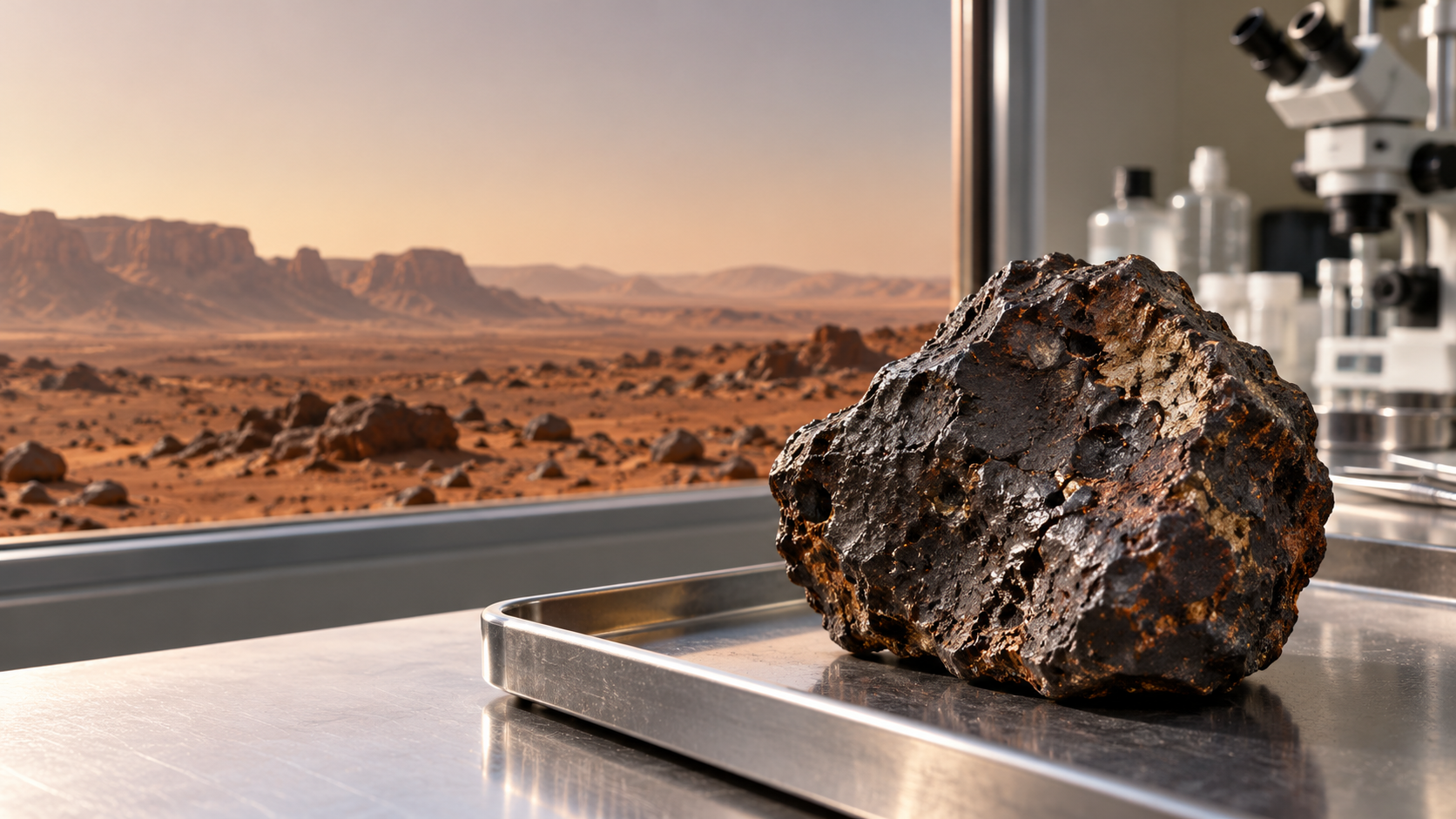
A rose-colored meteorite discovered in the Sahara Desert has been identified as a fragment of Mars, according to reports describing the specimen as approximately 4.1 billion years old. The rock preserves material from the planet’s ancient crust and may contain evidence that heated water once moved through Martian rocks.
The reported age places the meteorite among the oldest known pieces of Mars available for laboratory study. Its importance comes not from its unusual color alone, but from the mineral, chemical, and isotopic evidence linking it to the Red Planet. Research on the specimen may help scientists reconstruct how Mars formed, how its crust changed, and how water interacted with rocks during the planet’s earliest geological history. Source 1
What Is the Rose-Colored Meteorite Found in the Sahara?
A fragment of Martian crust
A meteorite is material from space that survives passage through Earth’s atmosphere and reaches the ground. Most meteorites originate from asteroids, but a small number come from the Moon or Mars.
The Sahara specimen is reported to be a Martian meteorite associated with the planet’s crust. Its reported age of 4.1 billion years refers to when the rock or its constituent minerals formed or crystallized on Mars. It does not mean that the meteorite landed in the Sahara at that time. The rock likely formed in ancient Martian crust, was blasted into space by an impact, and eventually reached Earth.
Why the Sahara is important for meteorite discoveries
Deserts provide favorable conditions for finding and preserving meteorites. The Sahara receives little rainfall, so rocks undergo less weathering than they would in humid environments. Sparse vegetation also leaves much of the ground exposed, allowing unusual stones to stand out against sand and gravel.
Meteorite hunters assess possible specimens by their shape, density, surface texture, and contrast with the surrounding terrain. A dark fusion crust may form when a rock heats during atmospheric entry, although meteorites do not all look alike.
Finding an unusual stone is only the first step. Scientists must confirm that it is a meteorite and determine its origin.
What the rose color may indicate
The meteorite’s rose-colored appearance makes it distinctive, but color alone cannot prove a Martian origin. A rock’s surface may reflect its mineral composition, oxidation, weathering, or atmospheric entry effects.
Laboratory analysis provides stronger evidence. Researchers can examine the specimen’s mineral structure, elemental composition, isotopic ratios, and internal gases. These features can distinguish a Martian meteorite from an ordinary terrestrial rock or an asteroid fragment.
The color may help researchers recognize the specimen in the field, but its scientific value comes from the geological record preserved inside it.
How Scientists Identify a Rock From Mars
Mineral and chemical fingerprints
Martian meteorites contain mineral combinations and chemical signatures consistent with rocks observed on Mars by orbiters, landers, and rovers. Scientists compare samples with spacecraft data and established collections of Martian meteorites.
Important evidence can include:
- Mineral structure and crystal form.
- Ratios of major and trace elements.
- Isotopic composition.
- Textures created by volcanic, thermal, or water-related processes.
- Signs of alteration after the rock formed.
A Martian rock may also contain minerals formed under conditions uncommon on Earth. The combination of minerals matters more than any single component because individual minerals occur in rocks from multiple planetary environments.
Reports identify the Sahara specimen as material from the Martian crust and associate it with a geological history reaching back approximately 4.1 billion years. Source 3
Trapped gases provide a decisive clue
Some Martian meteorites contain tiny pockets of gas trapped inside minerals. Their composition can resemble the Martian atmosphere measured by spacecraft and landers.
This comparison is powerful because atmospheric gases can act as a planetary fingerprint. If gases inside a meteorite match the known composition of Mars’s atmosphere, the evidence strongly supports a Martian origin.
Scientists generally combine gas measurements with mineralogy, chemistry, isotopic data, and geological textures. Multiple independent lines of evidence are necessary because meteorites can be altered during their journey through space and by exposure to Earth’s environment.
The meteorite’s crustal origin
A crustal origin makes the meteorite especially valuable. The crust records how a planet’s surface formed and changed. It can preserve traces of volcanic activity, impacts, heat, pressure, and interaction with water.
Scientists can use a crustal meteorite to study:
- The formation of early Martian rocks.
- Volcanic and intrusive activity.
- Mineral stability under ancient conditions.
- Fluid circulation through fractures.
- Changes in Mars’s surface and subsurface environments.
The specimen is not necessarily representative of every region of Mars. It records the history of one fragment from one geological setting. Its significance lies in the specific information it preserves and how that information compares with broader observations of the planet.
Why the Meteorite Is Estimated to Be 4.1 Billion Years Old
Dating the rock’s formation
Scientists estimate the age of ancient rocks through radiometric dating. Certain radioactive elements decay into daughter products at predictable rates. By measuring the ratio between a parent isotope and its decay products, researchers can estimate when minerals formed.
Different dating systems work across different timescales and mineral types. When several methods produce consistent results, confidence in the age increases.
An age of approximately 4.1 billion years indicates that the meteorite’s minerals formed during the early history of Mars. The reported age records formation or crystallization, not the duration of the meteorite’s journey to Earth. Source 7
What Mars was like 4.1 billion years ago
Mars was likely more geologically active during its early history than it is today. The young planet may have experienced stronger volcanic activity, greater internal heat, and a thicker atmosphere. Surface and underground water may also have played a larger role.
Mars gradually lost much of its atmospheric protection. As the atmosphere thinned, the planet became colder and less capable of maintaining stable surface liquid water. Geological activity also declined as the interior cooled.
A 4.1-billion-year-old crustal rock comes from a time before much of that transformation. It may preserve evidence of an early Mars that differed substantially from the cold, dry world visible today. The rock may broadly belong to the period associated with the Noachian era, although precise classification depends on technical data and geological features identified in the sample.
Age alone does not tell the whole story
A radiometric age provides a crucial time marker, but it does not describe every event in a rock’s history. The meteorite may have passed through several stages:
- Minerals formed in the ancient Martian crust.
- Heat or water altered some of those minerals.
- A large impact excavated the rock from Mars.
- The fragment traveled through interplanetary space.
- It entered Earth’s atmosphere and landed in the Sahara.
- It remained exposed until discovery and analysis.
Each stage can leave a different signature. Scientists therefore study not only when the rock formed, but also how it changed afterward.
What the Meteorite Reveals About Ancient Mars
Evidence of early geological activity
The meteorite offers physical material from Mars’s early crust rather than only remote measurements. Researchers can examine its minerals directly, using instruments that may be larger and more precise than equipment sent aboard a spacecraft.
The sample may help scientists determine how early Martian crust formed, which minerals were stable, and how heat from the planet’s interior affected surface rocks. It may also provide clues about volcanic or intrusive processes.
These findings contribute to broader research on planetary evolution. Mars is smaller than Earth and cooled more quickly, but it still experienced complex geological processes. Its rocks preserve a record of how a terrestrial planet changes as its atmosphere, internal heat, and water supply evolve.
Signs of water-driven alteration
Reports describe mineralogical evidence suggesting that hydrothermal activity occurred on ancient Mars. Hydrothermal activity occurs when heated water moves through rock, often because of volcanic or geothermal heat.
As hot water circulates, it can:
- Dissolve existing minerals.
- Deposit new minerals in fractures.
- Change the rock’s chemical composition.
- Form veins and alteration zones.
- Transport elements through the rock.
Minerals produced or modified by these processes can preserve evidence of ancient water-rock interaction. The meteorite may therefore record a period when fluids moved through Martian crust. Source 5
This evidence does not automatically indicate a global ocean, long-lived rivers, or a particular climate. Water may have moved through underground fractures, interacted with volcanic rocks, or circulated after an impact.
Why hydrothermal systems matter
Hydrothermal environments interest planetary scientists because they can remain active below the surface even when surface conditions become cold or dry. On Earth, geothermal systems create chemical and thermal gradients that support complex reactions.
Martian hydrothermal systems may have formed near volcanic regions, impact sites, or areas with residual internal heat. Researchers study them as possible environments where water, heat, and minerals interacted.
These conditions are relevant to habitability, meaning that an environment could support life. They do not show that life existed there.
A meteorite can demonstrate that water and heat affected ancient rock without providing biological evidence. Determining whether Mars ever supported life requires separate evidence, such as biological structures, organic chemistry with a clear origin, or other unambiguous markers.
How a Martian Rock Reached Earth
An impact blasted the rock off Mars
The most likely launch mechanism is a powerful impact. An asteroid or comet striking Mars could excavate material from the crust and accelerate fragments beyond the planet’s gravitational hold.
The resulting debris would travel through space as impact ejecta. Most fragments would fall back onto Mars or remain in orbit, but some could escape and enter trajectories that eventually cross Earth’s path.
A Martian meteorite does not indicate that Mars expelled the material through ordinary volcanic activity. The energy required to launch a rock from Mars is generally associated with a major impact.
The journey through space
A Martian fragment can drift through the Solar System for an uncertain period before reaching Earth. Its travel time is separate from its geological age.
Three dates should be distinguished:
- Formation age: When the minerals formed on Mars.
- Ejection age: When an impact launched the rock into space.
- Terrestrial arrival: When the fragment entered Earth’s atmosphere and landed.
The 4.1-billion-year figure describes the first category. Additional measurements may help determine when the rock was ejected, but that event may have occurred far more recently than the rock’s formation.
Atmospheric entry and discovery
During atmospheric entry, the meteorite’s outer surface can heat and melt, sometimes forming a dark fusion crust. The interior may remain relatively protected, preserving minerals and gases formed on Mars.
Researchers document a meteorite’s location, mass, shape, surface, and relationship to surrounding material. This information helps establish provenance and supports later laboratory analysis.
A specimen found in a desert also requires careful handling. Earthly moisture and contamination can alter minerals or obscure chemical signatures. Researchers therefore preserve representative samples and use controlled laboratory procedures.
Why Scientists Study Martian Meteorites
Physical samples available on Earth
Martian meteorites are among the few samples of Mars available for detailed analysis on Earth. Laboratories can apply multiple techniques to a small fragment, including microscopy, isotope measurement, mineral spectroscopy, and chemical analysis.
Researchers can revisit the same sample as new analytical methods become available. This flexibility makes meteorites valuable complements to spacecraft data.
Meteorites also have limitations. Their exact locations on Mars are usually unknown, and their geological context has been lost. A rock collected directly from Mars would include information about its surrounding terrain, position, and relationship to nearby layers.
Complementing rover and orbiter observations
Orbiters provide regional and global views of Martian landscapes. They can map minerals, identify volcanic structures, and measure surface composition across large areas.
Rovers examine rocks at specific landing sites, providing images, mineral data, and local geological context.
Meteorites add high-resolution laboratory information. Scientists can compare their findings with orbital measurements and rover observations to determine whether a meteorite resembles a known type of Martian terrain.
Together, these sources create a more complete picture of Mars’s geological history.
Testing models of Mars’s evolution
Martian meteorites help researchers evaluate models of:
- Crust formation.
- Volcanic activity.
- Water circulation.
- Atmospheric loss.
- Impact history.
- Planetary cooling.
Each specimen represents a limited location and geological history. Its evidence becomes more powerful when combined with other samples and spacecraft observations.
What This Discovery Cannot Prove
The meteorite can provide evidence of ancient crustal formation and water-related alteration, but it cannot independently prove that life existed on Mars.
It also cannot establish that:
- The entire planet once had a warm, wet climate.
- The rock came from a precisely identified location.
- Hydrothermal activity lasted for a specific length of time.
- Ancient Mars had a global ocean.
- Biological processes caused the mineral changes.
Scientific descriptions should distinguish among evidence, interpretation, and proof. Mineral changes may be consistent with hydrothermal activity, but researchers must investigate alternatives such as volcanic heating or impact-related fluids.
Open Questions About the Martian Meteorite
Where on Mars did the rock originate?
The precise source region may remain unknown. Researchers can compare the meteorite’s mineral composition with orbital observations, but matching a small fragment to a specific Martian landscape is difficult.
Impact-launch models can provide clues about the type of terrain that produced the sample and the conditions under which it escaped Mars. An exact location, however, may require a distinctive chemical or mineral match with remotely observed terrain.
How extensive was hydrothermal activity?
The mineral evidence may reflect a localized event or a broader underground system. Scientists may investigate whether heat came from volcanic activity, residual geothermal energy, a major impact, or circulation through deep fractures.
Mineral relationships, chemical zoning, and isotope data can help distinguish among these possibilities.
What can the sample reveal about ancient water?
Researchers may study the temperature, chemistry, and duration of the fluids that altered the rock. Water could have circulated briefly after a volcanic event, moved through underground fractures, or appeared during impact-related heating.
Evidence of water in a rock does not automatically indicate surface rivers or oceans. It may instead record a subsurface environment isolated from the surface.
Frequently Asked Questions
How old is the rose-colored meteorite found in the Sahara?
The meteorite is reported to be approximately 4.1 billion years old. This age refers to the formation or crystallization of its minerals on Mars, not the date it landed on Earth.
How do scientists know that it came from Mars?
Scientists identify Martian meteorites using mineral composition, elemental chemistry, isotopic measurements, and gases trapped inside minerals. These characteristics can be compared with data collected from Mars by spacecraft and landers.
What does the meteorite reveal about ancient Mars?
The sample preserves material from the ancient Martian crust. Its minerals may provide information about early volcanic activity, crust formation, and water-driven alteration during a period when Mars was younger and more geologically active.
What is hydrothermal activity on Mars?
Hydrothermal activity occurs when heated water moves through rock, often because of volcanic or geothermal heat. The process can dissolve existing minerals, create new ones, and leave chemical evidence of past water-rock interaction.
Does the meteorite prove that life existed on Mars?
No. Evidence of water and hydrothermal activity may identify environments relevant to habitability, but it does not prove that life existed. Biological evidence would require separate and more direct indicators.
How did a piece of Mars reach Earth?
A powerful asteroid or comet impact likely blasted rock from Mars’s crust into space. Some fragments eventually followed paths that crossed Earth’s orbit, entered the atmosphere, and landed as meteorites.
Conclusion: A Small Meteorite With a Planetary History
The rose-colored meteorite found in the Sahara is reported to be a 4.1-billion-year-old fragment of Mars. Its mineral and chemical characteristics identify it as Martian crustal material, while its altered minerals may preserve evidence of hydrothermal activity on ancient Mars.
The specimen’s unusual color made it noticeable, but its geological record makes it important. Inside a rock small enough to study in an Earth laboratory lies evidence of Mars’s early crust, internal heat, water-rock interaction, impact history, and transformation into the cold desert planet observed today.
Every Martian meteorite provides only a limited view of the planet. This sample cannot explain the entire history of Mars or prove that life existed there. It can, however, give scientists direct access to ancient planetary material and help connect laboratory measurements with observations from orbiters, landers, and rovers. The result is a clearer understanding of how Mars evolved and how water, heat, and minerals shaped its earliest geological environments.
Artikel Terkait
-
 100th U.S. ISS Spacewalk Deploys New Solar Array
-
 Haast’s Eagle: Did Giant Eagles Hunt Human Children?
-
 New Map Reveals Structure in the Milky Way’s Empty Space
-
 4.1-Billion-Year-Old Martian Meteorite Reveals Ancient Mars
-
 ED138: A Possible New Dwarf Planet Beyond Pluto
-
 Why Comets Probably Did Not Bring Life to Earth